Buffalo's $1 Urban Homestead Program: How Selling Homes for One Dollar Can Revitalize a City
By Daniel Amodeo, President of Amo Realty
Why Would a City Sell a House for Just $1?
At first glance, it sounds too good to be true.
Why would a city sell a home for just one dollar instead of trying to get as much money as possible?
The answer is surprisingly simple: in many cases, an abandoned property is actually costing a city money rather than making it money.
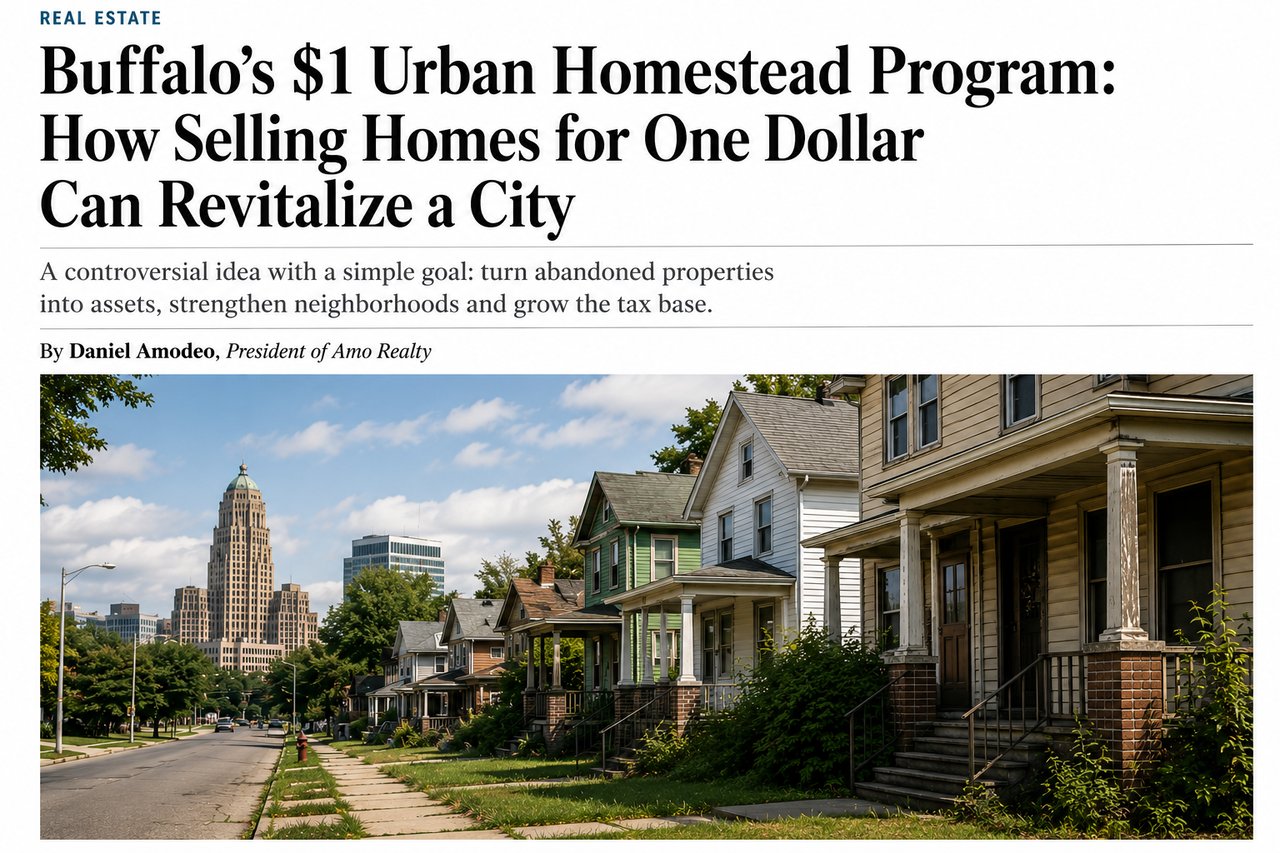
Vacant homes often become targets for vandalism, fires, illegal dumping, and code enforcement issues. They can drag down neighboring property values, reduce tax revenue, and create safety concerns for entire neighborhoods. Instead of allowing these properties to continue deteriorating, some cities have chosen a different approach—sell them for a nominal price to buyers willing to restore them.
Buffalo's Urban Homestead Program
Buffalo, New York became one of the better-known examples of this concept through its Urban Homestead Program.
Under the program, qualifying buyers could acquire certain city-owned vacant homes or land for just $1 plus closing costs, provided they agreed to rehabilitate the property and satisfy various program requirements. The homes weren't simply handed away. Buyers had to demonstrate the financial ability to complete renovations and comply with occupancy and redevelopment requirements established by the city.
The purpose wasn't to maximize the sale price.
Instead, Buffalo sought to:
- Reduce neighborhood blight
- Return vacant properties to productive use
- Encourage homeownership
- Increase long-term property tax revenue
- Stabilize neighborhoods suffering from years of disinvestment

The House Costs More Than One Dollar
One of the biggest misconceptions about Buffalo's Urban Homestead Program is that buyers could simply purchase a home for $1 and move in.
In reality, the purchase price was usually the smallest expense.
Most homes required substantial rehabilitation, and buyers generally needed to complete repairs within required timeframes while complying with city standards. Participants also had occupancy requirements designed to ensure the homes became long-term residences rather than speculative investments.
For many participants, renovation costs reached tens of thousands of dollars—or more—depending on the property's condition.
Why Cities Sometimes Prefer $1 Over Market Value
From a municipal perspective, an abandoned house sitting vacant often produces little or no tax revenue.
Instead, it may require inspections, maintenance, boarding, mowing, demolition planning, police responses, and other public resources.
If a qualified buyer restores that property, the city gains something much more valuable than a higher purchase price:
- A renovated home
- A neighborhood with fewer vacant buildings
- Increased surrounding property values
- A homeowner invested in the community
- Future property tax revenue year after year
In many cases, those long-term benefits far outweigh the proceeds from selling a neglected property at auction.
A Concept Used Beyond Buffalo
Buffalo wasn't the first city to explore urban homesteading.
Versions of similar programs have existed in cities including New York City, while municipalities across the country have experimented with transferring vacant public property to homeowners, nonprofit organizations, or developers willing to rehabilitate neglected neighborhoods.
Although each program differs, the philosophy remains remarkably consistent.
A vacant property producing little value can become an occupied home that contributes to the neighborhood and local tax base for decades.
Cities such as Detroit and Cleveland have also spent years addressing large inventories of vacant homes through land banks, redevelopment initiatives, and programs designed to return abandoned properties to productive use. While each city has taken a different approach, the overall goal has remained the same: reduce blight, encourage private investment, stabilize neighborhoods, and generate long-term property tax revenue instead of allowing homes to sit vacant.
Internationally, Italy has attracted worldwide attention with its €1 home programs, where participating towns offer abandoned properties at a nominal purchase price in an effort to attract new residents and encourage investment. Like Buffalo's program, the purchase price is only one piece of the equation, as buyers are typically expected to renovate the property and meet the specific requirements established by the municipality.
Final Thoughts
Buffalo's $1 Urban Homestead Program wasn't really about giving away houses.
It was about transforming liabilities into assets.
By encouraging buyers to renovate abandoned homes, the city sought to reduce blight, strengthen neighborhoods, and create future taxpayers rather than maintaining inventories of deteriorating properties.
While a $1 purchase price grabs headlines, the true investment has always been the time, money, and commitment required to bring these homes back to life.