Trinity County, California Real Estate: Home Prices, Housing Market & 2026 Statistics
Updated August 2026
Trinity County is one of California’s most unusual housing markets. While the statewide median price for an existing single-family home remains close to $900,000, the median price in Trinity County was just $250,000 in July 2026, according to the California Association of Realtors.
That makes Trinity County housing roughly 72% less expensive than the California statewide median based on July 2026 figures.
But the enormous price difference does not necessarily mean Trinity County is an undiscovered version of suburban California where homes simply happen to cost a fraction as much.
Trinity County is a fundamentally different market.
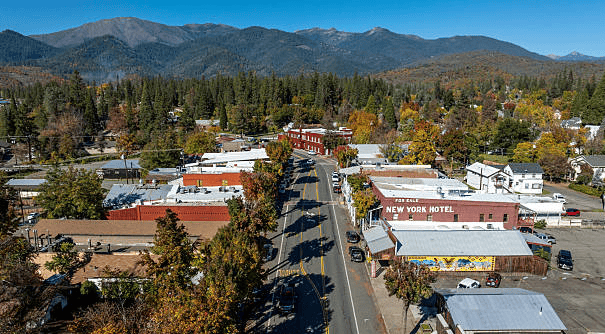
It is extraordinarily rural, sparsely populated, mountainous and relatively isolated from California's major employment and population centers. Those characteristics help explain both its affordability and its appeal to buyers looking for land, privacy and outdoor recreation.
Trinity County Real Estate at a Glance
July 2026 median single-family home price: $250,000
California median home price: $887,680
Difference from statewide median: Approximately 72% lower
June 2026 Trinity County median: $352,480
July 2025 Trinity County median: $240,500
July 2026 year-over-year price change: +4.0%
July 2026 month-over-month price change: -29.1%
Estimated 2025 population: 15,720
Land area: 3,179 square miles
Population density: Approximately 5.1 residents per square mile as of the 2020 Census
Owner-occupied housing rate: 71.7%
Median household income: $53,002
Median gross rent: $1,073
Households with broadband internet: 81.9%
Sources: California Association of Realtors and U.S. Census Bureau. Housing, income and internet figures are based primarily on 2020-2024 Census estimates.
How Cheap Is Trinity County Compared With California?
The difference is enormous.
The California Association of Realtors reported a $887,680 statewide median price for an existing single-family home in July 2026.
Trinity County's median for the same month was $250,000.
In other words, the statewide median-priced California home cost approximately 3.6 times as much as the median-priced home sold in Trinity County.
For buyers accustomed to Los Angeles, San Diego, Silicon Valley, Orange County or the San Francisco Bay Area, a $250,000 California median can sound almost unbelievable.
The explanation is largely supply and demand.
Trinity County does not have the employment base, population, accessibility or concentration of amenities that drive housing demand in California's metropolitan markets.
Trinity County Home Prices Can Be Volatile
One important caveat is that monthly Trinity County statistics should not be interpreted in the same way as statistics from Los Angeles or San Diego.
Trinity County is a very small housing market with relatively few transactions. A handful of expensive or inexpensive sales can therefore have an outsized effect on the monthly median.
C.A.R. data illustrates this clearly.
The county's reported median price was:
January 2026: $290,000
May 2026: $515,000
June 2026: $352,480
July 2026: $250,000
That does not mean a typical Trinity County house lost more than half its value between May and July.

It reflects, at least in part, the extremely small number of transactions occurring in the county.
C.A.R. specifically noted this issue when discussing July 2026 county-level sales data, explaining that unusually large percentage changes in smaller counties such as Trinity can be driven by low transaction volumes rather than a broad change in market conditions.
For that reason, buyers, sellers and journalists should be careful about drawing conclusions from a single month's percentage change.
Why Is Trinity County Real Estate So Affordable?
Several characteristics separate Trinity County from most of California.
1. Trinity County is extremely rural
Trinity County encompasses approximately 3,179 square miles of land but had an estimated population of only 15,720 in 2025.
That works out to only about five people per square mile based on 2020 Census density figures.
There simply isn't the population pressure found in California's major metropolitan areas.
2. It is far from major employment centers
California's highest housing prices tend to cluster around major employment centers and highly desirable coastal communities.
Trinity County has neither a major metropolitan area nor a large corporate employment center.
For households dependent on commuting to a large employment market, that dramatically reduces the number of potential buyers.
3. The local employment base is small
The Census Bureau reported only 234 employer establishments in Trinity County in 2023, employing approximately 1,426 people.
Median household income was approximately $53,002 according to 2020-2024 Census estimates.
Local wages and employment opportunities therefore do not support the kind of housing prices seen in California's largest economic centers.
4. Getting around can take time
Living in a county with more than 3,000 square miles and a tiny population means residents should expect distance.
The Census Bureau reports a 27.2-minute average commute, but that number alone does not capture the practical realities of living in a remote mountainous county.
Access to shopping, medical services, airports, entertainment and other amenities can require substantially more planning than it would in a metropolitan area.
5. Rural living isn't for everyone
The characteristics that attract one buyer can discourage another.
Privacy, acreage and isolation may be exactly what one household wants. Another buyer may prioritize restaurants, shopping, nightlife, major hospitals, large employers and convenient transportation.
That difference dramatically reduces the potential buyer pool compared with metropolitan California.
What Do Buyers Look for in Trinity County?
At Amo Realty, we receive inquiries from buyers interested in property throughout rural Northern California, including buyers looking at Trinity County.
A significant portion of the interest is not simply for conventional suburban-style homes.
Buyers may be searching for:
- Vacant land and acreage
- Farms and rural properties
- Recreational land
- Cabins and mountain homes
- Properties offering privacy
- Second homes
- Properties near outdoor recreation
- Homes for buyers who work remotely
- Lower-priced alternatives to California's metropolitan markets
Many inquiries come from buyers already living elsewhere in California who are surprised by how much less expensive land and housing can be in the region. Others come from out-of-state buyers.
Land Is Part of the Trinity County Story
Looking only at traditional home prices misses an important part of the local real estate market.
Trinity County's enormous geographic footprint and low population density make land an important component of buyer interest.
Someone searching for a property here may be less concerned about proximity to a downtown business district and more concerned about acreage, access, topography, water, utilities, road conditions, recreational opportunities or privacy.
That makes Trinity County fundamentally different from the typical California housing market.
The Natural Appeal of Trinity County
Affordability is only one reason people consider the area.
Trinity County describes itself as largely underdeveloped and encompassing approximately 3,200 square miles of mountainous Northern California terrain.
Outdoor attractions include the Trinity Alps, Trinity Lake and Trinity River, along with opportunities for hiking, mountain biking, fishing, boating and other outdoor recreation.
For someone whose image of California consists primarily of Los Angeles freeways or densely populated coastal communities, Trinity County can feel like another state entirely.
The county's isolation is simultaneously one of its biggest disadvantages and one of its biggest attractions.
Could Remote Work Increase Demand?
Remote work changed the equation for some California households.
Historically, living far from a major employment center made areas like Trinity County impractical for many professionals.
A worker who must report to an office in Silicon Valley several days per week cannot realistically substitute Trinity County for a Bay Area suburb.
But a fully remote worker has considerably more geographic freedom.
That creates an interesting long-term possibility for rural California: households earning metropolitan-area salaries may no longer need to live within commuting distance of metropolitan-area employers.
There is an important limitation, however.
The Census Bureau estimates that 81.9% of Trinity County households had a broadband internet subscription during 2020-2024, below universal coverage. Reliable high-speed internet can be particularly important to anyone considering a rural property specifically because they plan to work remotely.
Buyers should investigate internet availability at the individual property level rather than assuming that service available elsewhere in the county will be available at a particular address.
Housing Supply in Trinity County
The Census Bureau estimated 8,148 housing units in Trinity County as of July 2025.
The county's certified 2024-2029 Housing Element provides additional context. Using 2022 data, it reported approximately 8,201 housing units, of which about 5,483, or 66.9%, were occupied.
Importantly, a substantial portion of vacant housing consisted of properties intended for seasonal, recreational or occasional use.
When seasonal vacancies were excluded, the county estimated an ownership vacancy rate of approximately 2.7% and a rental vacancy rate of approximately 5.5%.
This is another reason a raw vacancy statistic can be misleading in a recreational and rural market.
A vacant mountain property used seasonally is very different from an unwanted vacant house in a declining urban neighborhood.
Homeownership Is High
Approximately 71.7% of occupied housing units were owner-occupied according to Census estimates for 2020-2024.
That is consistent with a market where ownership, land and rural properties play a particularly important role.
The Census Bureau also estimated the median value of owner-occupied housing units at $325,800 for the 2020-2024 period.
That number should not be confused with C.A.R.'s $250,000 July 2026 median sale price.
They measure different things: the Census statistic estimates the value of the overall owner-occupied housing stock over a multi-year survey period, while the C.A.R. statistic reflects existing single-family homes actually sold during a particular month.
Trinity County Population
The U.S. Census Bureau estimated Trinity County's population at 15,720 as of July 1, 2025, compared with an estimates base of 16,116 in April 2020.
That represents an estimated population decline of approximately 2.5% over that period.
The county is also older than many communities.
Approximately 30.1% of residents were age 65 or older in the Census Bureau's latest QuickFacts release.
Demographics matter to housing because a rapidly growing working-age population generally creates different housing pressures than a small, older and relatively stable or declining population.
Trinity County Economy
Several statistics illustrate just how small the local economy is:
Employer establishments, 2023: 234
Employment at those establishments, 2023: 1,426
Annual payroll, 2023: Approximately $66.5 million
Nonemployer establishments, 2023: 846
Retail sales, 2022: Approximately $116.1 million
Accommodation and food-service sales, 2022: Approximately $17.9 million
Median household income, 2020-2024: $53,002
Per-capita income, 2020-2024: $31,301
These figures help explain why comparing Trinity County home prices directly with Silicon Valley or coastal Southern California can be misleading.
Housing prices ultimately depend on what the local and incoming buyer pool can and will pay.

The Tradeoffs Behind a $250,000 California Home
Buyers considering Trinity County should understand that the lower purchase price comes with tradeoffs.
A buyer may gain acreage, privacy, scenery and a much lower acquisition price while giving up convenient access to some services, employment centers and amenities.
Rural properties can also present issues that are less common with conventional suburban homes. Depending on the property, buyers may need to investigate wells, septic systems, private roads, utility access, internet availability, property boundaries, easements, zoning, fire risk and insurance availability.
Those issues should be evaluated property by property.
Is Trinity County an Undiscovered California Housing Market?
Perhaps -- but "undiscovered" should not be confused with "destined to boom."
Trinity County possesses several characteristics that could attract more buyers over time: relatively inexpensive housing, land, extraordinary natural surroundings, privacy and the increased ability of some professionals to work remotely.
At the same time, the very factors that have kept the county affordable -- isolation, limited employment and fewer amenities -- are not easily changed.
That tension is what makes Trinity County interesting.
Greater connectivity, remote employment and migration from expensive California metros could increase demand. But substantial development could also alter precisely the rural character and connection to nature that attract many people to the county in the first place.
Daniel Amodeo on the Trinity County Housing Market
The California Association of Realtors recently published data about the $250,000 median home price of Trinity County.
Trinity County is almost an entirely different real estate market from the California most people picture. Its rural location, small population, limited jobs and distance from major commercial centers all help keep housing demand -- and prices -- significantly lower than in coastal California and the state's major metropolitan areas. It's really a supply-and-demand issue.
A $250,000 median price sounds almost unbelievable in California, but that affordability comes with tradeoffs. Buyers can get substantially more property and land for their money than in many parts of California, but they're also choosing a rural lifestyle with fewer nearby services and longer drives. There's also a much smaller buyer pool when they eventually resell.
For the right buyer -- especially someone looking for privacy, beautiful land, clean air, hiking and outdoor recreation, or someone who doesn't need to commute to work -- Trinity County offers a level of affordability that's increasingly difficult to find anywhere in California.
The area is really beautiful and is a well-kept secret in California. It's just very rural and hard to get to.
About Daniel Amodeo
Daniel Amodeo is President of Amo Realty and a licensed California real estate broker. He founded the brokerage in 2007. Amo Realty operates across 14 states and 23 major metropolitan areas and provides real estate brokerage services in California, including Trinity County.
Media inquiries:
Daniel Amodeo
President, Amo Realty
781-910-3000
[email protected]
Sources and Methodology
Housing market figures for July 2026 are from the California Association of Realtors July 2026 Home Sales and Price Report.
Population, housing, income, employment, broadband, commute and demographic statistics are from the U.S. Census Bureau, including 2020-2024 American Community Survey estimates and 2025 population estimates.
Housing occupancy and seasonal vacancy information is from the Trinity County 2024-2029 Housing Element, certified August 27, 2025.
Geographic and recreational information is from Trinity County and local tourism resources.
Real estate market commentary represents the analysis and observations of Daniel Amodeo and Amo Realty. Monthly median sale prices in low-volume counties can fluctuate substantially and should not be interpreted as an appraisal or prediction of an individual property's value.