Opportunity Zones 2.0: 2027 Statistics and State-by-State Analysis
Updated September 2026
The next generation of Qualified Opportunity Zones will take effect January 1, 2027, bringing significant changes to the geographic footprint of the federal Opportunity Zone program.
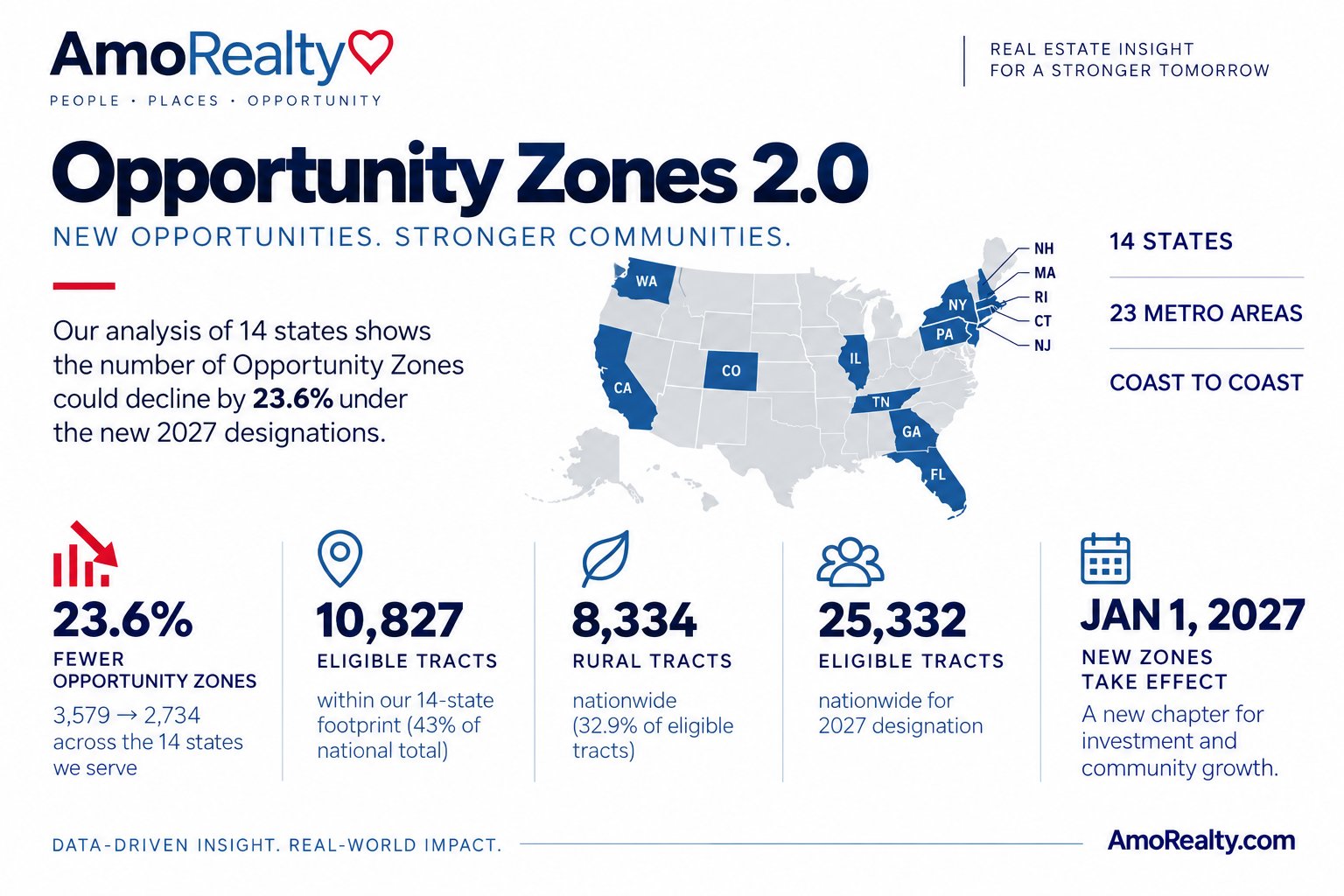
An Amo Realty analysis of current Opportunity Zone and 2027 eligibility data finds that the 14 states where Amo Realty operates could see the number of Opportunity Zones decline from 3,579 under the original program to approximately 2,734 under Opportunity Zones 2.0 — a reduction of 845 zones, or 23.6%.
Nationwide, the U.S. Treasury has identified 25,332 census tracts eligible for nomination as 2027 Qualified Opportunity Zones. Of those, 8,334 — approximately 32.9% — are entirely rural.
Approximately 6,544 tracts are anticipated to ultimately receive Opportunity Zone designation nationwide, compared with 8,764 under the original Opportunity Zone program.
Opportunity Zones 2.0 in the 14 States Served by Amo Realty
State | OZ 2.0 Eligible Tracts | Anticipated 2027 Zones | Current Zones |
|---|---|---|---|
California | 2,469 | 618 | 879 |
New York | 1,702 | 426 | 514 |
Florida | 1,360 | 340 | 427 |
Illinois | 950 | 238 | 327 |
Georgia | 942 | 236 | 260 |
Pennsylvania | 866 | 217 | 300 |
New Jersey | 516 | 129 | 169 |
Tennessee | 507 | 127 | 176 |
Massachusetts | 410 | 103 | 138 |
Washington | 394 | 99 | 139 |
Colorado | 360 | 90 | 126 |
Connecticut | 243 | 61 | 72 |
Rhode Island | 55 | 25 | 25 |
New Hampshire | 53 | 25 | 27 |
TOTAL | 10,827 | 2,734 | 3,579 |
Key Findings
23.6% fewer Opportunity Zones: Across the 14 states served by Amo Realty, the number of zones is anticipated to decline from 3,579 to approximately 2,734.
845 zones could disappear from the footprint: The 14-state total represents 845 fewer Opportunity Zones than under the original program.
California faces the largest reduction: California is projected to go from 879 Opportunity Zones to approximately 618, a decline of 261 zones or roughly 30%.
Pennsylvania could lose more than one-quarter of its zones: Pennsylvania is projected to decline from 300 current Opportunity Zones to approximately 217 under OZ 2.0.
Washington and Colorado could see reductions approaching 30%: Washington is projected to decline from 139 to 99 zones, while Colorado could decline from 126 to 90.
More than 10,000 tracts are eligible within Amo Realty's footprint: The 14 states contain 10,827 census tracts currently eligible to be considered for OZ 2.0 designation, representing approximately 43% of all eligible tracts nationwide.
What This Means for Real Estate Investors
"The shrinking number of Opportunity Zones makes the actual locations selected for 2027 even more important for real estate investors," said Daniel Amodeo, President of Amo Realty. "A tax incentive alone doesn't make a property a good investment. The strongest Opportunity Zones will be places where the tax benefits overlap with real fundamentals such as housing demand, job growth, redevelopment and infrastructure investment."
Investors should begin researching eligible areas before the new designations take effect rather than waiting until 2027. Property values, rents, development pipelines, zoning, employment growth and population trends can help distinguish areas with genuine investment potential from locations that simply receive an Opportunity Zone designation.
About the Data
The U.S. Treasury and IRS have identified 25,332 low-income census tracts eligible for nomination as 2027 Qualified Opportunity Zones, including 8,334 tracts classified entirely as rural.
States generally may nominate no more than 25% of their eligible low-income census tracts, subject to special rules for states with smaller numbers of eligible tracts.
The anticipated state designation counts presented above are estimates based on current statutory limits and 2020–2024 American Community Survey data. Final Opportunity Zone selections are made through the state nomination and U.S. Treasury certification process and therefore may differ from these estimates.
The new Opportunity Zone designations take effect January 1, 2027.
Sources: U.S. Department of the Treasury; Internal Revenue Service; U.S. Census Bureau 2020–2024 American Community Survey; OpportunityZones.com.
Analysis: Amo Realty, September 2026.
Attribution: Daniel Amodeo / President / Amo Realty / https://amorealty.com/