
NYC Pied-à-Terre Tax Statistics: What Second-Home Owners Could Pay in 2026–2027
Amo Realty analysis — August 2026
Published by: Daniel Amodeo, President of Amo Realty
New York City's new pied-à-terre tax could add tens of thousands — and in some cases hundreds of thousands — of dollars per year to the cost of owning a second home in New York City.
An Amo Realty analysis of the city's new 2026–2027 surcharge rates and NYC Department of Finance data found that the tax can start at $40,000 per year and exceed $300,000 annually on some qualifying properties.
The potential impact is also overwhelmingly concentrated in Manhattan.
Key Findings
- 89.6% of properties identified in the NYC Comptroller's earlier analysis of the potential tax base were in Manhattan.
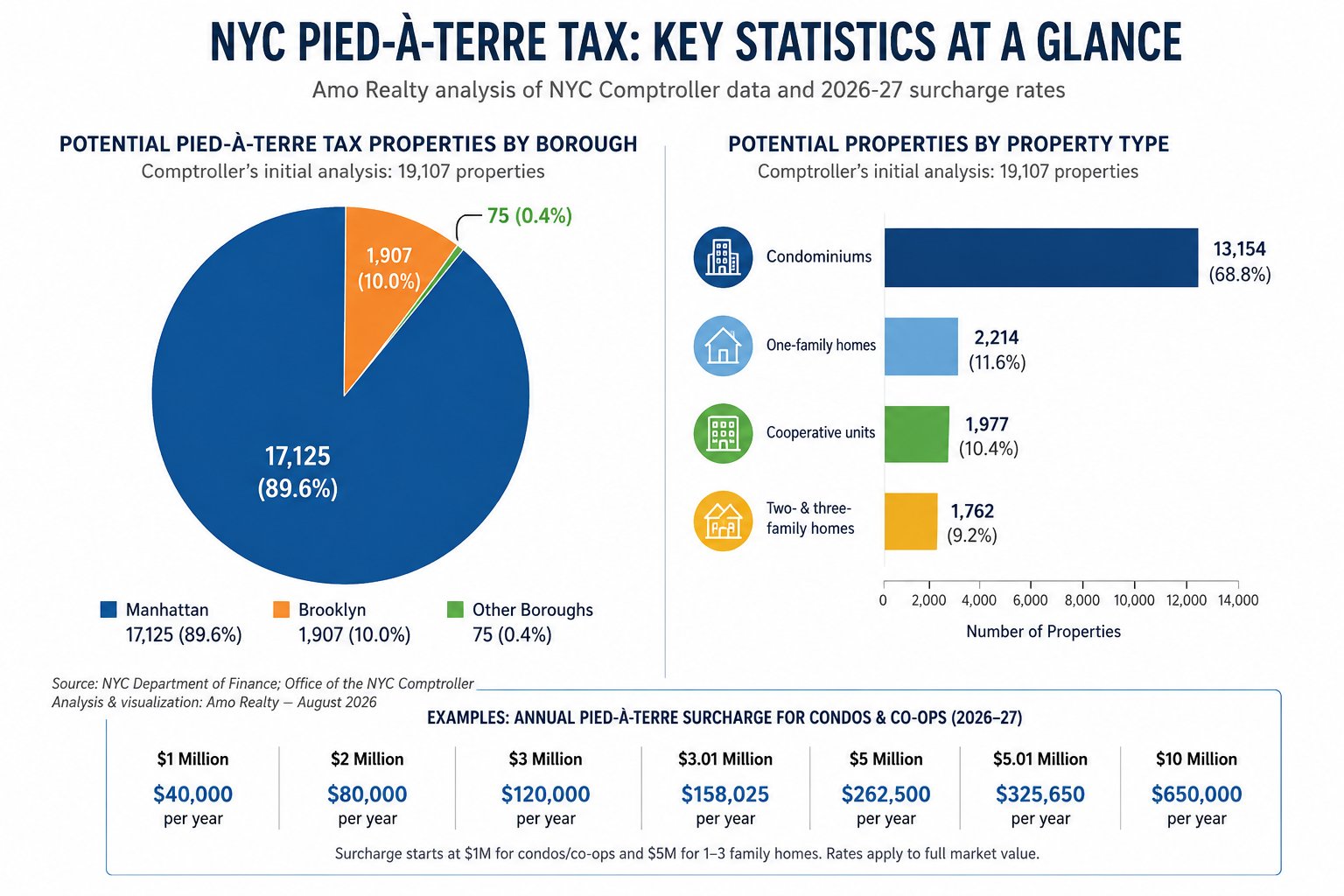
- The Comptroller initially identified 19,107 properties meeting its screening criteria, including 17,125 in Manhattan.
- After adjusting condo and co-op values to better approximate which properties would meet the applicable value threshold, the Comptroller estimated approximately 11,226 properties could potentially fall within the tax base before primary-residence, rental and behavioral adjustments.
- NYC's Department of Finance subsequently sent approximately 17,000 property owners notices that their properties may be subject to the new surcharge.
- A qualifying condo or co-op with a DOF market value of $1 million can face a $40,000 annual surcharge.
- At a $3 million DOF value, that surcharge is $120,000 annually.
- Crossing just above the $3 million threshold creates a substantial tax increase: a $3.01 million condo or co-op would face approximately $158,025 per year.
- A $5 million condo or co-op at the 5.25% rate would face a $262,500 annual surcharge.
- At $5.01 million, the 6.5% bracket produces a surcharge of approximately $325,650 per year.
Potential Pied-à-Terre Properties Are Heavily Concentrated in Manhattan
The NYC Comptroller analyzed Department of Finance data while the pied-à-terre proposal was being developed and identified 19,107 properties meeting its initial screening criteria.
Of those:
Location | Properties | Share |
|---|---|---|
Manhattan | 17,125 | 89.6% |
Brooklyn | 1,907 | 10.0% |
Other boroughs | 75 | 0.4% |
NYC Total | 19,107 | 100% |
That means approximately 9 out of every 10 properties in the Comptroller's initial potential tax pool were located in Manhattan.
Potential Properties by Type
The Comptroller's initial analysis identified:
Property Type | Properties |
|---|---|
Condominiums | 13,154 |
One-family homes | 2,214 |
Cooperative units | 1,977 |
Two- and three-family homes | 1,762 |
Total | 19,107 |
Condominiums alone represented 68.8% of the initial pool.
Condos and cooperative apartments combined represented 79.2%.
After adjusting condo and co-op values, the Comptroller reduced its estimated potential tax base from 19,107 properties to approximately 11,226 properties, before accounting for primary residences, rentals and changes in owner behavior.
What the 2026–2027 Pied-à-Terre Tax Can Cost
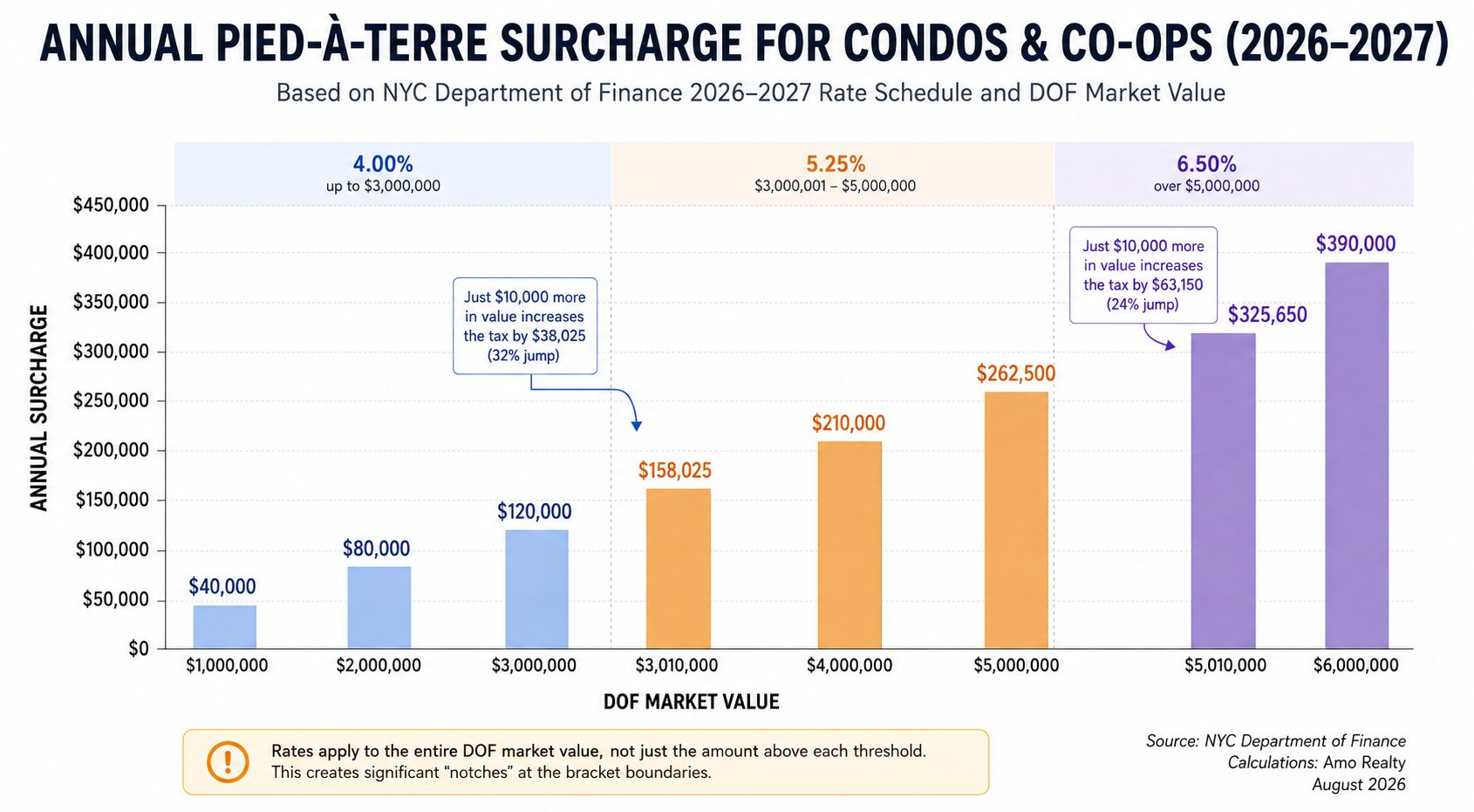
For the 2026–2027 tax year, New York City uses a special surcharge schedule for qualifying condominiums and cooperative apartments.
Condos and Co-ops
DOF Market Value | Rate | Approx. Annual Surcharge |
|---|---|---|
$1,000,000 | 4.00% | $40,000 |
$1,500,000 | 4.00% | $60,000 |
$2,000,000 | 4.00% | $80,000 |
$2,500,000 | 4.00% | $100,000 |
$3,000,000 | 4.00% | $120,000 |
$3,010,000 | 5.25% | $158,025 |
$4,000,000 | 5.25% | $210,000 |
$5,000,000 | 5.25% | $262,500 |
$5,010,000 | 6.50% | $325,650 |
$6,000,000 | 6.50% | $390,000 |
The rates apply to the property's entire DOF market value rather than only the amount exceeding each threshold.
That produces unusually large jumps at the bracket boundaries.
For example, moving from a DOF market value of $3 million to $3.01 million increases the calculated annual surcharge from $120,000 to $158,025 — an increase of $38,025 despite the property's value increasing by only $10,000.
Similarly, moving from $5 million to $5.01 million increases the surcharge from $262,500 to $325,650 — a $63,150 increase.
One- to Three-Family Homes
Qualifying one-, two- and three-family homes use a different schedule.
DOF Market Value | Rate | Approx. Annual Surcharge |
|---|---|---|
$5,000,000 | 0.80% | $40,000 |
$7,500,000 | 0.80% | $60,000 |
$10,000,000 | 0.80% | $80,000 |
$15,000,000 | 0.80% | $120,000 |
$15,010,000 | 1.05% | $157,605 |
$20,000,000 | 1.05% | $210,000 |
$25,000,000 | 1.05% | $262,500 |
$25,010,000 | 1.30% | $325,130 |
$30,000,000 | 1.30% | $390,000 |
The same bracket effect exists for houses.
A property moving from $15 million to $15.01 million in DOF market value sees its calculated surcharge rise from $120,000 to $157,605, while crossing from $25 million to $25.01 million increases it from $262,500 to $325,130.
The Long-Term Cost of Keeping a NYC Second Home
Because this is an annual surcharge, its effect becomes much larger for long-term owners.
Assuming the 2026–2027 surcharge rates remained unchanged purely for illustration:
Annual Surcharge | 5 Years | 10 Years |
|---|---|---|
$40,000 | $200,000 | $400,000 |
$80,000 | $400,000 | $800,000 |
$120,000 | $600,000 | $1,200,000 |
$210,000 | $1,050,000 | $2,100,000 |
$325,000 | $1,625,000 | $3,250,000 |
This is why the tax could affect the economics of pied-à-terre ownership even among buyers wealthy enough to afford multimillion-dollar Manhattan properties.
“The question for many wealthy second-home owners isn't whether they can afford another $40,000 or $100,000 a year,” said Daniel Amodeo, President of Amo Realty. “It's whether owning an apartment they may use only part of the year continues to make financial sense.”
“For someone who already owns a home in the Hamptons and keeps an apartment in Manhattan for convenience, an additional six-figure annual carrying cost can change that calculation.”
Methodology
Amo Realty calculated surcharge examples by applying the rates published by the New York City Department of Finance for the 2026–2027 property tax year to hypothetical DOF market values.
Geographic and property-type statistics were calculated from the Office of the New York City Comptroller's 2026 analysis of Department of Finance property data.
The Comptroller's dataset should not be interpreted as a list of properties that ultimately owe the surcharge. Properties can be exempt, including when they are used as a primary residence by an owner, qualifying family member or tenant.
Receiving a Department of Finance notice also does not necessarily mean an owner will ultimately owe the surcharge.
Sources: New York City Department of Finance; Office of the New York City Comptroller
Analysis and calculations: Amo Realty
Published: August 2026