Manufactured Home Prices vs. Traditional Home Prices: 2026 Data
August 2026 | Amo Realty Housing Market Statistics
Manufactured housing remains one of the lowest-cost paths to homeownership in the United States, but comparing the price of a manufactured home with a traditional home requires an important distinction: the advertised price of a manufactured home may not include the land beneath it.

In June 2026, the median sales price of a new site-built single-family home in the United States was $398,300, according to the U.S. Census Bureau.
By comparison, manufactured homes can be purchased for around $100,000, depending on size, configuration and location.
The difference in the cost of the structure can be substantial. The final cost to the homeowner, however, depends heavily on land, site preparation, installation, financing and property classification.
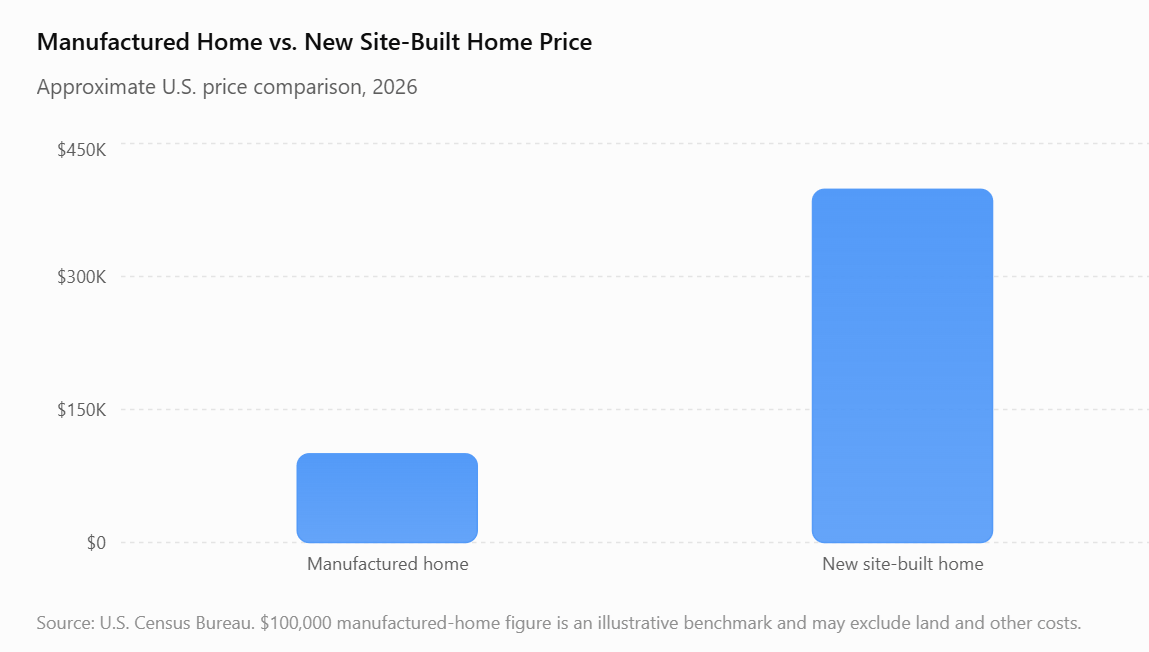
Based on these figures, a manufactured home priced at $100,000 costs approximately 75% less than the median new site-built home sold in June 2026.
The difference between the two price points is $298,300.
Another way to look at the comparison: the median new site-built home costs approximately four times as much as a $100,000 manufactured home.
This illustrates the significant cost advantage factory-built housing can offer at the structure level.
It does not, however, mean that a buyer can necessarily become a homeowner for $100,000.
The Cost of Land Changes the Comparison
One of the largest variables in manufactured housing is land.
A conventional home purchase generally includes both the structure and underlying land. A quoted manufactured-home price may represent primarily the home itself.
A manufactured-home buyer may also need to pay for:
- Land
- Site preparation
- Foundation work
- Transportation and installation
- Utility connections
- Permits and local fees
- Driveways and grading
- Insurance
- Financing expenses
For that reason, the same manufactured home can have dramatically different total costs depending on where it is located.
A manufactured home placed on inexpensive land in a rural or lower-cost market could maintain a substantial affordability advantage over conventional construction.
In a high-cost metropolitan area, the price of a residential lot could eliminate a significant portion of those savings.
The most useful comparison is therefore not simply manufactured home price versus traditional home price.
The more complete calculation is:
Manufactured Home + Land + Site Preparation + Installation + Utilities + Permitting + Financing = Total Cost of Homeownership
The Manufactured-Home Price Gap
The $298,300 gap is a comparison of price points, not necessarily the amount a buyer would save.
Manufactured-home prices may exclude land, site preparation, transportation, installation, utility connections, permitting and other costs that are incorporated into the value of many conventional real estate purchases.
That distinction becomes particularly important when comparing manufactured housing across different parts of the country.
Financing Manufactured Homes
Financing can differ substantially from financing a conventional house.
A manufactured home permanently attached to land owned by the homeowner may be classified as real property and potentially qualify for traditional mortgage financing, subject to lender and program requirements.
Other manufactured homes are classified as personal property and may be financed through personal-property loans, commonly referred to as chattel loans.
These loans can have different interest rates, terms and underwriting requirements than conventional mortgages.
As a result, consumers should compare more than purchase prices. Monthly financing costs can materially affect the affordability advantage of a lower-priced manufactured home.
Land Ownership and Home Equity
Whether the homeowner owns the underlying land can also influence long-term wealth creation.
A manufactured home installed on land owned by the homeowner combines the physical structure with a land asset.
Land values can appreciate based on location, housing demand and scarcity.
A manufactured home located on leased land presents a different financial situation. The homeowner owns the structure but continues paying for the right to occupy the land.
That distinction can affect:
- Long-term appreciation
- Financing availability
- Resale demand
- Monthly housing costs
- Property classification
- The owner's ability to build equity
For this reason, manufactured homes located on owned land and homes located on leased lots should not necessarily be treated as equivalent investments.
Do Manufactured Homes Depreciate?
The assumption that every manufactured home depreciates like an automobile oversimplifies the market.
Long-term value depends on several factors, including:
- Land ownership
- Location
- Local housing demand
- Age and condition
- Quality of construction
- Foundation and installation
- Property classification
- Financing availability
- Comparable sales
- Community or lot fees
A permanently installed manufactured home sold together with desirable land represents a substantially different real estate asset from a movable structure located on rented land.
The land component can be particularly important in determining whether the overall property appreciates over time.
Manufactured Housing and Starter Homes
Manufactured housing could provide another source of entry-level housing inventory.
The economics of conventional starter-home construction have become increasingly difficult in many markets because builders face high land, labor, material, financing and regulatory costs.
Factory construction can reduce the cost of the physical structure.
If manufactured housing becomes more widely permitted on residential lots, buyers in some markets could have an additional alternative to traditional starter homes.
At a large enough scale, that could create additional competition in the entry-level housing market.
The effect would likely vary considerably by region because land prices and zoning restrictions remain local.
Zoning Is a Major Variable
Local land-use rules are one of the biggest factors determining where manufactured housing can expand.
Manufactured homes historically have been more prevalent in rural areas and dedicated manufactured-home communities.
Greater acceptance of modern manufactured housing on individual residential lots could increase the number of locations where lower-cost factory-built homes are economically viable.
Construction cost alone, however, cannot overcome restrictive zoning.
An inexpensive home cannot increase housing supply in a community if there is no legal or economically feasible place to put it.
Key 2026 Manufactured Housing Price Statistics
$398,300
Median U.S. sales price of a new site-built single-family home in June 2026.
$100,000
Illustrative manufactured-home price used in this analysis.
$298,300
Difference between the two price points.
Approximately 75%
How much lower the $100,000 manufactured-home price is than the June 2026 median new-home sales price.
Approximately 4X
The median new site-built home price compared with a $100,000 manufactured home.
These comparisons measure housing price points and should not be interpreted as comparisons of equivalent completed properties because manufactured-home prices may exclude land and other expenses.
What Determines the Final Cost?
For consumers comparing manufactured housing with traditional housing, five variables can have an especially large effect on the final economics.
Home price: Factory construction can substantially reduce the cost of the physical structure.
Land: Purchasing a residential lot can dramatically increase the total investment.
Financing: Mortgage eligibility and property classification can affect interest rates and monthly payments.
Installation and infrastructure: Site preparation, foundations, transportation and utilities add to the purchase price.
Location: Land values, zoning, taxes, insurance and housing demand vary considerably across markets.
These variables explain why manufactured housing can represent an exceptionally inexpensive ownership option in one market while providing much smaller savings in another.
Methodology
Amo Realty reviewed publicly available housing information from the U.S. Census Bureau and U.S. Department of Housing and Urban Development.
The $398,300 figure represents the U.S. Census Bureau's reported median sales price of new single-family houses sold in June 2026.
The approximately $100,000 manufactured-home price is used as an illustrative benchmark for comparing manufactured housing with new site-built housing. Actual manufactured-home prices vary based on size, specifications, location and other factors.
Amo Realty calculated the $298,300 price difference, approximately 75% difference and approximately 4X price multiple from those figures.
Manufactured-home prices may exclude land, site preparation, transportation, installation, utility connections, permitting and other costs. The figures therefore should not be interpreted as a comparison of equivalent completed properties.
Data is provided for informational purposes and should be independently verified before being used for financial, lending, investment or real estate decisions.
Sources
U.S. Census Bureau
Manufactured Housing Survey
U.S. Census Bureau and U.S. Department of Housing and Urban Development
New Residential Sales — June 2026
U.S. Department of Housing and Urban Development
Manufactured Housing and Financing Resources
About Amo Realty
Amo Realty is an independent real estate brokerage founded in 2007. The company operates across multiple U.S. states and metropolitan markets, working with buyers, sellers, investors and businesses.
Daniel Amodeo is President of Amo Realty and holds a B.S. in Economics from San Diego State University.