California Proposition 37: What a 3% Down Payment Could Actually Cost Homebuyers
Amo Realty analysis — August 2026
Published by: Daniel Amodeo, President of Amo Realty
California Proposition 37 could dramatically reduce the amount of cash some homebuyers need upfront — but it would not eliminate the cost of the other 17% of the down payment.
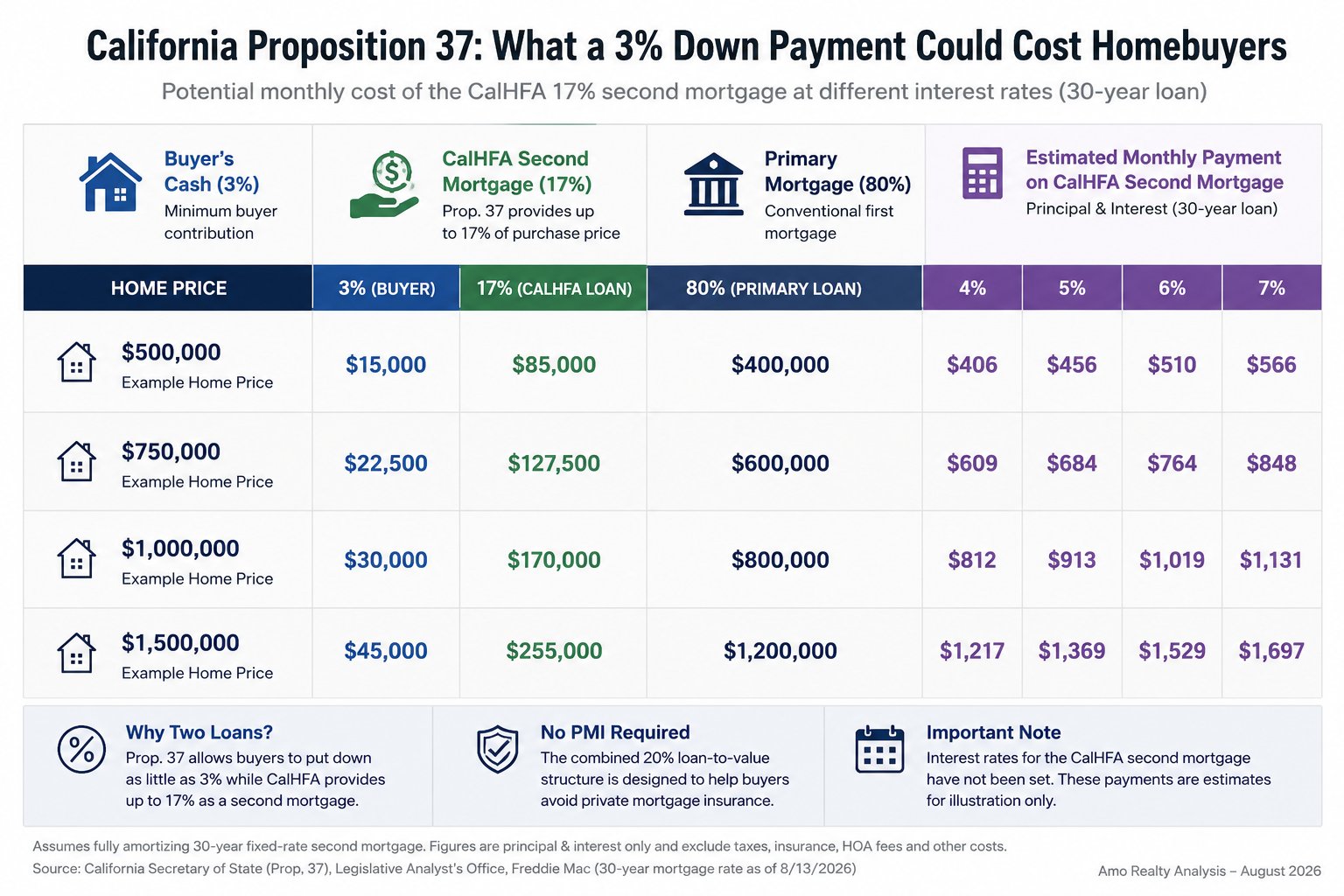
The November 2026 ballot measure would allow the California Housing Finance Agency (CalHFA) to provide qualifying buyers with a fixed-rate second mortgage covering up to 17% of the purchase price of a qualifying newly built home.
The buyer would contribute at least 3%, bringing the combined amount to 20%, while a conventional first mortgage could finance the remaining 80%.
The critical distinction is that the state's 17% is a loan, not a grant.
Because the interest rate for those second mortgages has not yet been established, Amo Realty calculated what the program could look like at several possible interest rates.
Key Findings
- On a $750,000 home, a buyer's 3% contribution would be just $22,500, compared with $150,000 needed for a traditional 20% down payment.
- The CalHFA second mortgage could provide another $127,500, or 17% of the purchase price.
- The buyer would therefore finance a total of $727,500, equal to 97% of the home's price, across two loans.
- At a hypothetical 4% rate, a 30-year $127,500 second mortgage would cost approximately $609 per month in principal and interest.
- At 5%, that payment would rise to approximately $684 per month.
- At 6%, it would be approximately $764 per month.
- At 7%, it would reach approximately $848 per month.
- On a $1 million home, the second mortgage could reach $170,000.
- A $170,000 second mortgage amortized over 30 years would cost approximately $812 per month at 4%, $913 at 5%, $1,019 at 6%, or $1,131 at 7%.
- Proposition 37 could eliminate a six-figure upfront savings hurdle for some buyers, but it does so largely by converting that upfront cost into additional long-term debt.
How Proposition 37's 3% Down Payment Would Work
The basic structure is straightforward.
For a buyer purchasing a qualifying $750,000 newly built California home:
Financing Source | Amount | Share of Price |
|---|---|---|
Buyer's cash | $22,500 | 3% |
CalHFA second mortgage | $127,500 | 17% |
Primary mortgage | $600,000 | 80% |
Total purchase price | $750,000 | 100% |
Instead of saving $150,000 for a conventional 20% down payment, the buyer could potentially purchase with $22,500 of their own money.
That's a difference of $127,500 in upfront cash.
But the buyer doesn't receive that $127,500 for free. It becomes a second mortgage that must be repaid.
How Much Could the Second Mortgage Cost?
Proposition 37 requires CalHFA to keep borrowers' interest costs as low as possible, but the actual interest rate has not yet been established.
Amo Realty therefore modeled 30-year fully amortizing second mortgages at rates ranging from 4% to 7%.
$500,000 Home
17% second mortgage: $85,000
Hypothetical Rate | Approx. Monthly Payment |
|---|---|
4% | $406 |
5% | $456 |
6% | $510 |
7% | $566 |
$750,000 Home
17% second mortgage: $127,500
Hypothetical Rate | Approx. Monthly Payment |
|---|---|
4% | $609 |
5% | $684 |
6% | $764 |
7% | $848 |
$1 Million Home
17% second mortgage: $170,000
Hypothetical Rate | Approx. Monthly Payment |
|---|---|
4% | $812 |
5% | $913 |
6% | $1,019 |
7% | $1,131 |
$1.5 Million Home
17% second mortgage: $255,000
Hypothetical Rate | Approx. Monthly Payment |
|---|---|
4% | $1,217 |
5% | $1,369 |
6% | $1,529 |
7% | $1,697 |
These figures illustrate why the eventual CalHFA interest rate will be one of the most important details for prospective buyers.
$750,000 Example: What Would the Two Loans Cost?
For illustration, consider a $750,000 qualifying home.
The buyer contributes:
$22,500
CalHFA potentially provides:
$127,500
The primary mortgage is:
$600,000
Using the August 13, 2026 national average 30-year fixed mortgage rate of approximately 6.67% as an illustrative rate, principal and interest on the $600,000 first mortgage would be approximately:
$3,860 per month
The second mortgage would then be added to that payment.
Hypothetical Second-Mortgage Rate | First Mortgage | Second Mortgage | Combined P&I |
|---|---|---|---|
4% | $3,860 | $609 | $4,469 |
5% | $3,860 | $684 | $4,544 |
6% | $3,860 | $764 | $4,624 |
7% | $3,860 | $848 | $4,708 |
These figures exclude property taxes, homeowners insurance, HOA fees and other ownership expenses.
The Trade-Off: $127,500 Less Cash Today, Another Mortgage Tomorrow
This may be the simplest way to understand Proposition 37.
On a $750,000 home:
Traditional 20% down payment: $150,000
versus
Prop. 37 buyer contribution at 3%: $22,500
The immediate difference is:
$127,500
For a household earning a strong income but without $150,000 sitting in savings, that difference could potentially move homeownership forward by years.
But financially, the program does not make the $127,500 disappear.
It allows the buyer to borrow it instead of saving it first.
Buying Now vs. Waiting for Mortgage Rates to Fall
The decision becomes more complicated for buyers who believe mortgage rates will decline.
As of August 13, 2026, the average U.S. 30-year fixed mortgage rate was approximately 6.67%.
A buyer could therefore face a choice between:
Buying sooner: Put 3% down and carry both a first and second mortgage.
Waiting: Continue saving toward a larger down payment while hoping mortgage rates eventually decline.
Neither strategy automatically produces more wealth.
A buyer who purchases sooner could benefit if the home appreciates while they own it. They also begin paying down principal sooner.
But waiting could prove advantageous if the buyer accumulates substantially more cash, mortgage rates fall, or home prices weaken.
The opposite is also possible: mortgage rates could remain elevated while California home prices rise, leaving the waiting buyer facing a more expensive property later.
Does Avoiding PMI Mean the Buyer Saves Money?
One potential advantage of combining the buyer's 3% contribution with the 17% CalHFA loan is that the financing structure could eliminate the need for private mortgage insurance.
But avoiding PMI does not automatically mean the second mortgage is cheaper.
The proper comparison is:
Cost of PMI
versus
Interest and payments on a second mortgage equal to as much as 17% of the home's value.
For a $750,000 purchase, that's potentially a $127,500 second loan.
For a $1 million purchase, it's potentially $170,000.
Until CalHFA establishes the interest rate and final loan terms, it is impossible to say universally whether the second-mortgage structure will cost less than PMI.
Refinancing Could Become More Complicated
Two mortgages also create another consideration: refinancing.
A homeowner with only one mortgage generally has one lender and one lien to address.
A Proposition 37 participant could have both a conventional first mortgage and a CalHFA second mortgage.
The practical refinancing options will depend on the final CalHFA program rules, including how the second lien is treated when a homeowner refinances the first mortgage.
That matters because buyers considering Proposition 37 shouldn't assume they can simply refinance both loans later if mortgage rates fall.
California's Housing Affordability Problem
The program is being proposed against an unusually expensive housing backdrop.
The California Association of Realtors reported a statewide median existing single-family home price of approximately $904,640 in June 2026.
At that price:
20% down = $180,928
3% down = $27,139
The difference is approximately:
$153,789
For many middle-income households, saving another $153,789 could take years.
That is the fundamental problem Proposition 37 is attempting to address: not necessarily whether a household has enough income to make a mortgage payment, but whether it can accumulate the upfront capital required to purchase a home.
What Proposition 37 Changes — and What It Doesn't
Proposition 37 potentially changes the timing of homeownership.
It could allow some households to buy years before they could accumulate a traditional down payment.
What it does not necessarily change is the fundamental cost of the house.
A $750,000 home remains a $750,000 home.
Instead of arriving with $150,000, a qualifying buyer could potentially arrive with $22,500 and finance another $127,500 through CalHFA.
That can be enormously valuable for the right household.
But it also means the buyer enters homeownership with substantially more leverage.
“The biggest advantage of Proposition 37 is time,” said Daniel Amodeo, President of Amo Realty. “There are California households with enough income to carry a home but who could spend years trying to accumulate a six-figure down payment while home prices continue moving around them.”
“The trade-off is debt. On a $750,000 home, reducing the buyer's cash requirement from $150,000 to $22,500 sounds dramatic because it is. But the other $127,500 doesn't disappear. The buyer is borrowing it.”
Amodeo added:
“I wouldn't look at this simply as 3% down versus 20% down. The real question for a buyer is whether the financial benefit of getting into a home sooner is worth carrying the additional second mortgage.”
Methodology
Amo Realty analyzed the official terms of California Proposition 37 published by the California Secretary of State and Legislative Analyst's Office.
Down-payment and loan amounts were calculated by applying the maximum 17% CalHFA assistance and minimum 3% buyer contribution described in Proposition 37 to hypothetical purchase prices of $500,000, $750,000, $1 million and $1.5 million.
Because Proposition 37 does not yet establish the actual interest rate borrowers would receive, second-mortgage payments are illustrative scenarios calculated at 4%, 5%, 6% and 7%, assuming a fully amortizing 30-year fixed-rate loan.
The $750,000 primary-mortgage example uses a 6.67% interest rate for illustration, reflecting the national average 30-year fixed mortgage rate reported for the week ending August 13, 2026.
Calculations include principal and interest only and exclude taxes, insurance, HOA fees, closing costs and other expenses.
Proposition 37 is scheduled for California's November 3, 2026 election and has not been enacted as of this analysis.
Disclaimer: This analysis is provided for informational purposes only. Data, program terms, rates and calculations may change or contain errors and should be independently verified before making financial or real estate decisions.
Sources: California Secretary of State; California Legislative Analyst's Office; California Association of Realtors; Freddie Mac
Analysis and calculations: Amo Realty
Published: August 2026