How the 2028 Olympics Are Reshaping Los Angeles Construction
Published by Daniel Amodeo, President of Amo Realty 6/28/2026
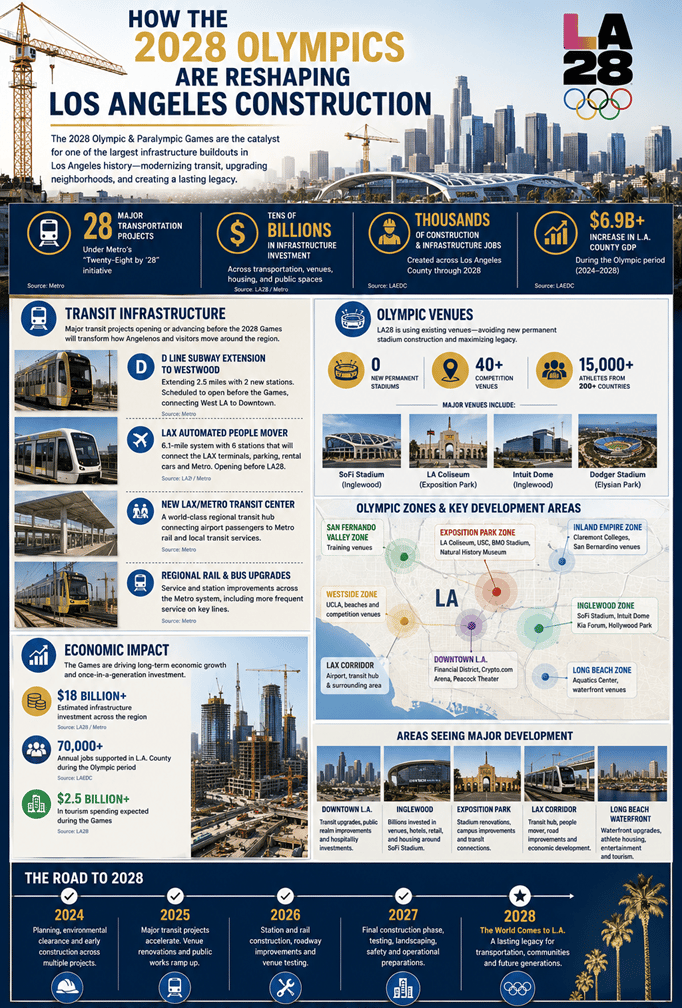
Long before the Olympic torch is lit in July 2028, Los Angeles will already have undergone one of the most significant periods of construction and infrastructure investment in its modern history.
Across Southern California, construction cranes have become part of the skyline. Crews are expanding Metro rail lines beneath city streets, rebuilding portions of Los Angeles International Airport, modernizing transportation corridors, and completing mixed-use developments that will welcome residents, businesses, and millions of visitors expected during the 2028 Summer Olympic and Paralympic Games.
While the Olympics themselves will last only a few weeks, the construction projects tied to LA28 are expected to influence Los Angeles for decades. Unlike previous host cities that invested heavily in new Olympic stadiums, Los Angeles is largely relying on existing world-class venues while directing billions of dollars toward transportation, public infrastructure, airports, housing, commercial real estate, and neighborhood revitalization.
For many residents, the most meaningful Olympic legacy may not be measured by medals or attendance records. Instead, it may be reflected in shorter commutes, expanded public transportation, revitalized districts, improved airport access, and new investment throughout communities across Los Angeles County.
The transformation is already visible.
Drive through Inglewood today, and it's difficult to ignore how dramatically the city has changed over the past decade. SoFi Stadium has become one of the country's premier sports and entertainment venues, Intuit Dome has added another landmark to the skyline, and new hotels, restaurants, apartments, and retail developments continue to reshape the surrounding area. Similar construction activity can be found throughout Downtown Los Angeles, Long Beach, Exposition Park, Hollywood, and neighborhoods surrounding Los Angeles International Airport.
Much of that development extends beyond the Olympics themselves.
Many transportation projects now underway had already been proposed years before Los Angeles secured the Games. Winning the Olympic bid didn't necessarily create these projects—it accelerated them. Large international events often create fixed deadlines that encourage governments, transit agencies, and developers to move projects from planning to construction.
Transportation has become one of the defining themes of LA28.
For decades, Los Angeles has been known as one of America's most automobile-dependent cities. Although the Metro system has steadily expanded over the past several years, preparations for the Olympics have placed additional emphasis on improving mobility throughout Southern California. New subway extensions, airport transportation improvements, rail modernization projects, pedestrian enhancements, and expanded public transit connections are designed not only for Olympic spectators but also for the millions of people who live and work throughout the region.
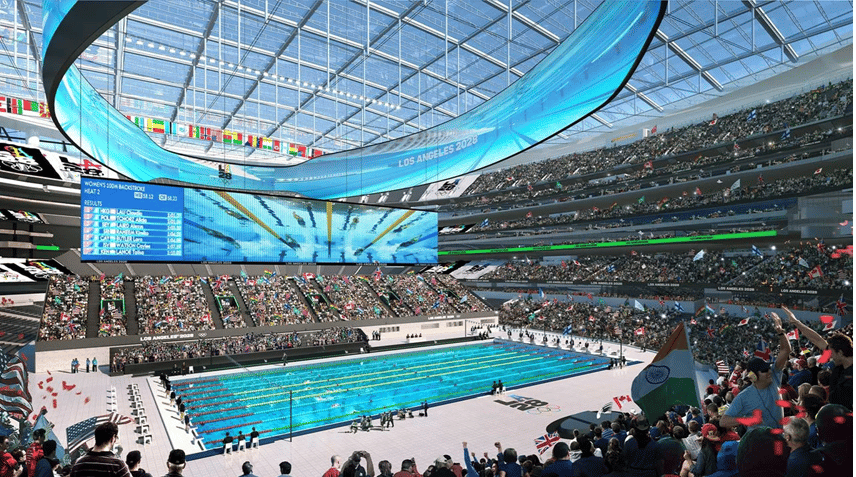
2028 Stadium - Rendering courtesy of LA28
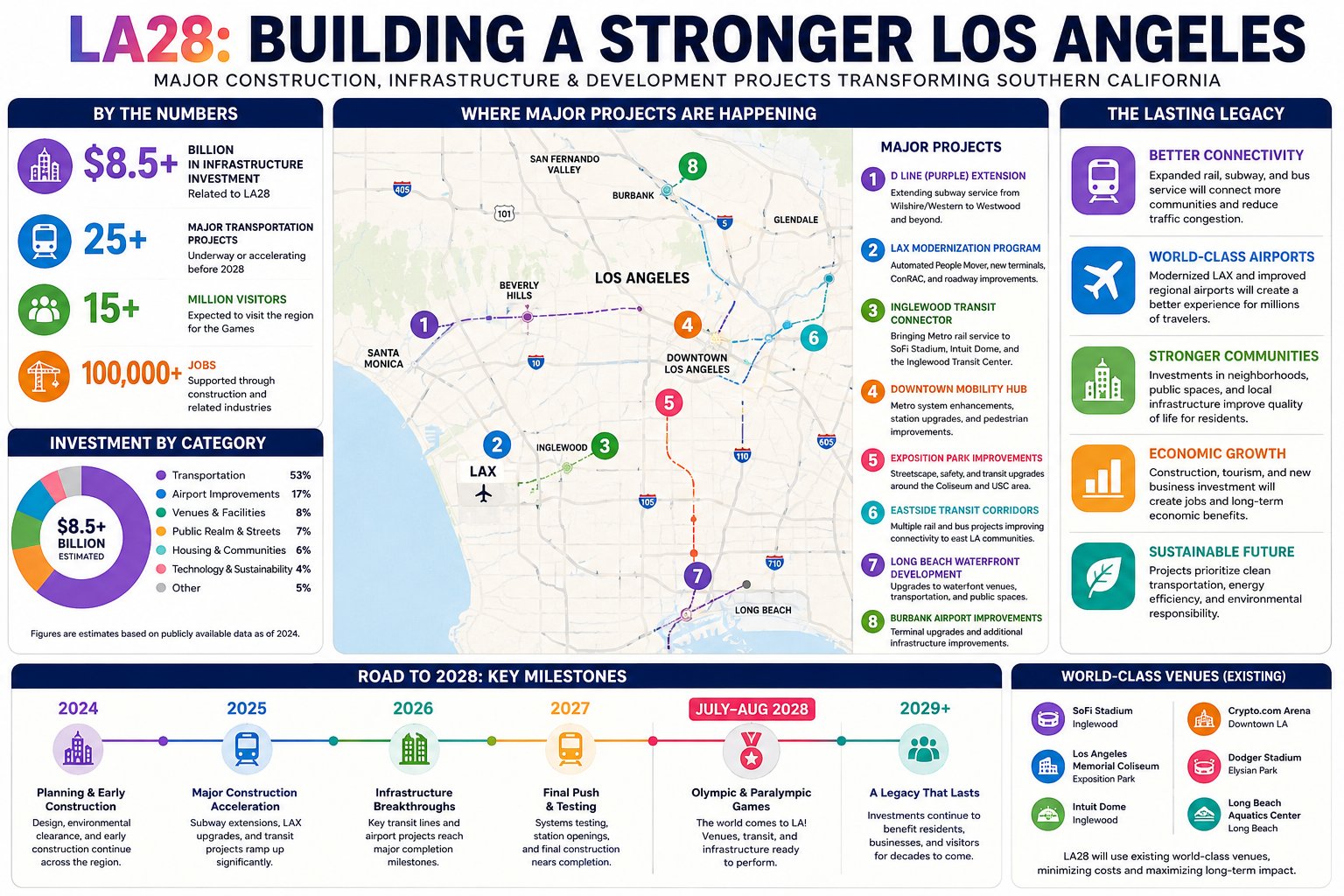
The D Line Extension is one of the largest transportation projects currently under construction. Once completed, the expanded subway line will connect more of Los Angeles to Downtown and the Westside while improving access to employment centers, entertainment districts, and residential neighborhoods. At Los Angeles International Airport, the Automated People Mover, Consolidated Rent-A-Car Facility, and other modernization projects are expected to dramatically improve the passenger experience while strengthening one of the world's busiest airports.
These investments illustrate an important difference between Los Angeles and many previous Olympic host cities.
Rather than constructing dozens of permanent athletic facilities that may see limited use after the Games, Los Angeles is emphasizing infrastructure that residents will continue using every day. Expanded Metro service, upgraded airport facilities, safer pedestrian corridors, improved transportation networks, and modernized public spaces are expected to provide long-term benefits that extend far beyond the closing ceremony.
That strategy has also created new opportunities throughout the Los Angeles real estate market.
As transportation infrastructure expands, developers continue identifying locations for residential communities, mixed-use developments, hotels, office buildings, retail centers, and entertainment projects. Areas that once sat outside convenient transit access are increasingly becoming attractive locations for future investment. Transit-oriented development has become an important planning strategy throughout Southern California, encouraging higher-density housing and commercial construction near major Metro stations.
The Olympics have also increased global attention on Los Angeles at a time when the city is already experiencing significant economic changes. Hosting one of the world's largest sporting events places Southern California in front of billions of television viewers while showcasing ongoing investment throughout the region. Beyond the athletic competition, LA28 represents an opportunity to highlight infrastructure improvements, economic development, tourism, architecture, and urban planning that will shape Los Angeles for years to come.
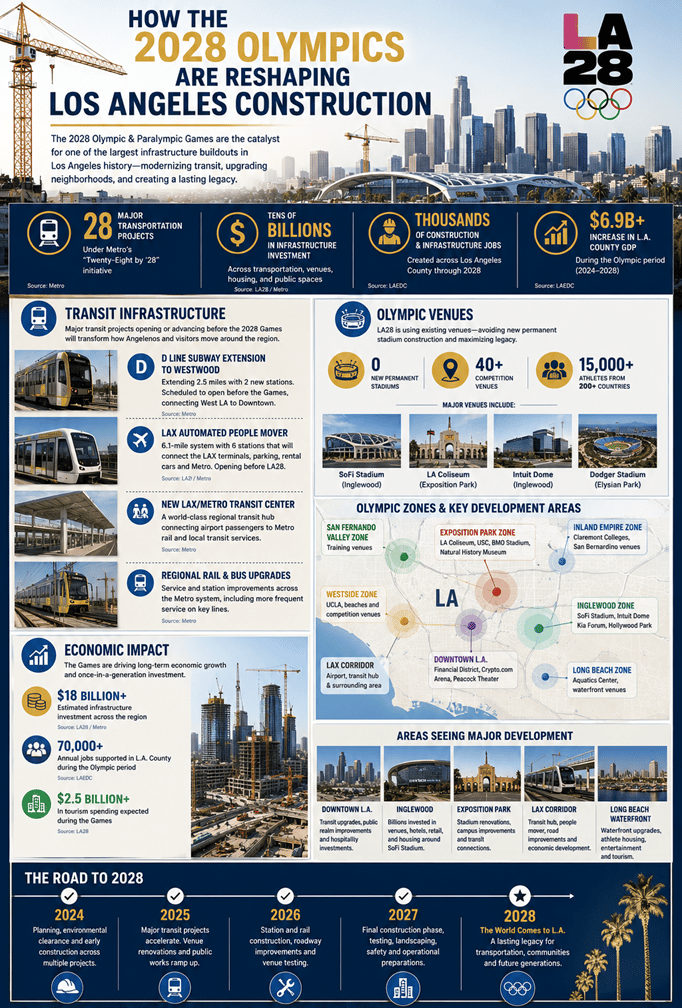
Major Los Angeles Construction Projects Before the 2028 Olympics
While dozens of public and private projects are contributing to the transformation of Southern California, several stand out because of their scale, economic impact, or long-term significance.
D Line (Purple Line) Subway Extension
The Metro D Line Extension is one of the largest transportation projects currently underway in Los Angeles. The expansion will connect Downtown Los Angeles with Beverly Hills, Century City, Westwood, and UCLA, providing faster transit access across one of the region's busiest corridors while supporting future residential and commercial development.
LAX Automated People Mover
The Automated People Mover is designed to connect airport terminals with Metro rail service, parking facilities, rental cars, and regional transportation. The project is expected to reduce congestion inside Los Angeles International Airport while significantly improving passenger mobility.
Consolidated Rent-A-Car Facility
The new Consolidated Rent-A-Car Center near LAX will centralize rental operations into a single location connected by the Automated People Mover. The facility is expected to streamline airport traffic while improving efficiency for millions of travelers each year.
Intuit Dome and Inglewood Development
The completion of Intuit Dome continues Inglewood's rapid transformation into one of Southern California's premier sports and entertainment destinations. New hotels, apartments, restaurants, retail centers, and infrastructure improvements continue reshaping the surrounding community.
Downtown Los Angeles Redevelopment
Downtown Los Angeles continues to experience significant investment through mixed-use residential towers, hotel construction, adaptive reuse projects, transit improvements, and entertainment district redevelopment. Olympic-related investment has accelerated interest in several surrounding neighborhoods.
How the Olympics Could Influence Los Angeles Real Estate
Large-scale infrastructure investment often affects nearby real estate markets over time. While no single project guarantees higher property values, improved transportation access and neighborhood investment frequently influence residential and commercial demand.
Potential long-term impacts include:
• Increased demand near Metro stations
• Transit-oriented residential development
• New apartment construction
• Mixed-use commercial projects
• Hotel development
• Office redevelopment
• Retail investment
• Adaptive reuse of existing buildings
• Public space improvements
• Streetscape modernization
Olympic Venues Across Los Angeles
Unlike many previous host cities, Los Angeles will utilize many existing world-class venues throughout Southern California.
Major competition venues include:
• SoFi Stadium
• Los Angeles Memorial Coliseum
• Intuit Dome
• Dodger Stadium
• BMO Stadium
• Long Beach Waterfront
• USC Sports Facilities
• UCLA Campus
• Santa Anita Park
• Sepulveda Basin Recreation Area
• Carson Sports Complex
Frequently Asked Questions
Will Los Angeles build new Olympic stadiums?
Very few permanent venues are being constructed specifically for the Games. LA28 is relying primarily on existing stadiums and arenas while directing investment toward transportation and public infrastructure.
What transportation projects are being completed before 2028?
Major projects include the Metro D Line Extension, LAX Automated People Mover, Consolidated Rent-A-Car Facility, regional rail improvements, Metro station upgrades, roadway improvements, and expanded pedestrian infrastructure.
How much is being invested?
Public agencies and private developers are investing tens of billions of dollars across transportation, aviation, housing, commercial real estate, entertainment, and infrastructure projects throughout Southern California.
Which neighborhoods are seeing the most development?
Major activity continues throughout Inglewood, Downtown Los Angeles, Exposition Park, Hollywood, Long Beach, West Los Angeles, Century City, areas surrounding LAX, and neighborhoods served by expanding Metro rail lines.
When will construction be completed?
Many projects are scheduled for completion before the 2028 Summer Olympic and Paralympic Games, while others will continue after the Games as part of long-term regional planning.
For builders, developers, investors, homeowners, and businesses, the years leading up to 2028 represent far more than preparation for an international sporting event. They mark one of the largest periods of public and private investment Southern California has experienced in generations. From subway tunnels beneath Wilshire Boulevard to redevelopment projects in Inglewood and airport modernization at LAX, the physical landscape of Los Angeles is changing in ways that will continue influencing the region long after the Olympic flame has been extinguished.